
Report of the Spier Dialogue May 2026
The Spier Dialogue
22 - 24 May 2026
SPIER WINE FARM
STELLENBOSCH, SOUTH AFRICA
"Every tragedy is dogged by a haunting amalgam of what-ifs rather than by people taking responsibility" – Greg Mills
A group of around 70 people gathered for the inaugural Spier Dialogue at the Spier estate in the Stellenbosch area to discuss Africa’s Demographic Revolution. The group included former presidents and prime ministers, government ministers, opposition leaders, diplomats, think-tank leaders, and business people.
The event was co-hosted by the Platform for African Democrats (PAD) and the Konrad-Adenauer-Stiftung (KAS), who are deeply grateful for the generous support and warm hospitality of Adrian and Dominique Enthoven, Mariota Enthoven and Angus McIntosh, and the entire Spier team.
Session 1: Africa's Demographic Moment — Dividend or Crisis?
Overview
The opening session framed one of the most consequential questions facing the continent: whether Africa's extraordinary population growth will translate into a demographic dividend — the economic acceleration that follows when a rising share of the population moves into working age — or whether it will instead produce social instability, underemployment, and political strain. The speakers agreed that the outcome is not predetermined. It will depend on decisions made in the next decade.
The demographic facts
Sub-Saharan Africa is on course to have the highest population of any region in the world by 2050, when one in four people on earth will live in the continent. Africa's population growth rate is the highest globally. Yet GDP per capita is not converging with the rest of the world — it is diverging. A rapidly growing population means the growth rate in output must outpace population growth simply to hold the average steady, let alone improve it.
Africa's median age is 19 years, compared to a range of 25 to 41 in countries that have already captured a demographic dividend. The working-age to dependent ratio — the core measure of demographic opportunity — remains below the threshold of 1.7 that enables the dividend to materialise. In 30 years, if fertility stabilises in the range of 2.1 to 2.8 children per woman, Africa will begin to enter this window. The question is whether the conditions to capture it will have been built by then.
"Demographics is like gravity — you can't escape it"
The four channels of the demographic dividend
The dividend, when it arrives, operates through four channels:
• Labour supply effect: A larger share of the population in working age expands the productive base of the economy.
• Savings and investment effect: Fewer dependents per worker increases the household savings rate, which drives capital accumulation.
• Human capital dividend: Smaller families invest more per child in education and health.
• Longevity effect: Longer lifespans extend the productive years of each worker and increase the returns to education.
China and the Asian tigers are the primary examples of countries that have fully captured all four channels, underpinned by deliberate population policy, sustained investment in human capital, and a rapid movement up the technology curve.
Why the dividend is not guaranteed
Several speakers pushed back on any assumption that demography alone will generate prosperity. South Africa was cited as a cautionary case: it has not converted its population structure into economic dynamism, and is in fact de-industrialising, with growth overly dependent on labour in low-productivity sectors.
The structural preconditions for a dividend are demanding. They include: universal access to quality healthcare (which determines how quickly the age profile of a country shifts); education systems capable of producing workers with the skills the modern economy requires; and, most critically, labour markets that can absorb millions of young people entering the workforce each year. Currently, African labour markets are failing on the last of these counts. Every year, millions of young Africans enter markets that cannot generate sufficient formal employment. The result is not the dividend, but its opposite: a youth unemployment bulge that becomes a source of frustration, instability, and emigration.
Migration patterns add complexity. Eighty per cent of African migration remains within the continent — people move to neighbouring countries, driven by economic necessity or climate shocks. This redistribution within the continent is significant and is largely absent from planning frameworks that focus only on national population figures.
The governance and institutional challenge
Several speakers argued that the central obstacle is not demographic but political. The African Union needs to engage these questions with the seriousness they demand. The old architecture of development finance — budget gaps closed by foreign aid, private sector gaps closed by foreign direct investment — is under strain. Aid budgets are contracting. The disruption of that model requires African governments to mobilise domestic resources and align their priorities accordingly.
The window for action is finite. Critical mineral agreements are being negotiated now, with some governments signing and others refusing. The terms on which African countries engage with China, Russia, and rising powers such as the UAE and Turkey will shape the fiscal and political space available for the next generation. There is an urgent need to build the political legitimacy, institutional strength, and policy coherence that would allow African governments to act strategically in this environment rather than reactively.
"It requires political legitimacy, strong institutions, proper policy and the right investment"
Technology and the growth equation
The final strand of the session addressed the relationship between demographics and technology. The conventional growth equation — output as a function of labour, capital, and technology — was extended to include entrepreneurial force and the capacity to use technology effectively.
Two constraints were identified as particularly acute in Africa. First, approximately 60% of the population lacks household electricity and broadband access. These are the preconditions for digital leapfrogging — without them, the potential of the digital revolution remains inaccessible. Second, the global automation of manufacturing in the developed world is compressing the industrialisation pathway that allowed previous generations of developing countries to absorb surplus labour. The question of how Africa diversifies its economic base and builds a path from informal to formal employment has no obvious historical precedent.
Artificial intelligence was identified as a potential enabler of personalised and differential knowledge at scale — a tool that could accelerate human capital development if the connectivity and policy conditions are in place to deploy it.
The central tension
The session closed with an unresolved tension at its core. The demographic dividend is not arriving now — it is a prospect for the 2050s and beyond, contingent on decades of sustained, well-governed investment. But the decisions that determine whether it arrives must be made now, in political systems that are under immediate pressure, in an international environment that is becoming less supportive, and with a youth population that cannot wait decades for the conditions of its prosperity to be built. Bridging the credibility gap between ambitious long-term goals and the reality of current governance is the essential political challenge.
Session 2: African Cities — Managing the Urban Transition
Overview
The second session addressed what may be the most concrete expression of Africa's demographic challenge: the acceleration of urbanisation. Ninety-five per cent of all future urban growth globally will occur in Africa and South-East Asia. The decisions made now about how African cities are governed, financed, and planned will shape the living conditions of hundreds of millions of people. The session drew on the experience of practitioners — a sitting mayor, a Kenyan urban administrator, and one of Africa's leading urban scholars — to examine what is working, what is failing, and what needs to change
The scale of the challenge
The numbers demand attention. Africa's urban population will double. Urbanisation in South Africa is currently estimated at 63%, and likely closer to 72% when displaced populations are included. Nairobi had 300,000 residents at independence and was built for that scale; today it has between 4 and 7 million people using infrastructure designed for a fraction of that number. The pattern is repeated across the continent.
The drivers of urban growth are structural. Seventy to ninety percent of urban workers in Africa are in the informal economy. The reason is not a failure of individual enterprise but a systemic one: African urbanisation has been disconnected from industrialisation. Cities have grown without the manufacturing and formal service sectors that, in previous periods of global development, generated the formal employment that absorbed rural migrants and created the fiscal base to fund urban infrastructure.
Leadership and vision in city government
The first contribution from a mayoral perspective focused on the internal conditions for effective city leadership. The argument was direct: transformation of a complex institution requires a clear and unambiguous vision, expressed as simply as possible, and a very short list of major reforms that are driven relentlessly. The most common mistake is attempting to address everything simultaneously. Focus and the willingness to talk constantly about both the direction and the standards expected of the organisation are prerequisites for change.
Two conditions for delivery were emphasised above all others. First, the default culture of large public institutions is risk aversion; overcoming it requires sustained, visible commitment from leadership to higher standards. Second, hiring is the most consequential act of a city leader. Every appointment either advances or undermines the vision. The largest leadership failures at the mayoral level have been hiring mistakes — appointments that looked adequate but proved unable to execute. More time invested in getting the right person, even for a single role, is almost always worth it.
Cities that work, across contexts, share a common foundation: essential infrastructure, reliably maintained. When that foundation is absent, cities deteriorate and lose their capacity to attract residents, visitors, and investors. Protecting it from the pressure for social spending — which is constant and often legitimate — is one of the core tasks of city leadership. But infrastructure alone is insufficient. Cities also need to be genuinely pleasant to live in: public spaces that are attractive and enjoyable, and a quality of daily experience that makes residents feel their city is working for them.
"Each hiring decision you make is an absolutely critical moment in your leadership journey. Do not settle for second best"
Revenue, autonomy, and the political economy of cities
The Kenyan experience illustrated a structural problem that is common across the continent. In Kenya's two-tier system of national and county government, the bulk of revenue is collected and retained at the national level. County governments — which are responsible for basic services — receive a limited share. The result, in Nairobi's case, is that the city's streetlighting bill alone consumes a significant proportion of its county allocation. There is no fiscal space to address accumulated infrastructure deficits.
A deeper problem was identified by the urban policy perspective: in many African countries, ruling national governments deliberately constrain the fiscal resources of cities when those cities are governed by opposition parties. Revenue streams are redirected, and city governments are reduced to performing administrative functions. This is not a design flaw in the system — it is the system operating as intended, to prevent political rivals from demonstrating competence. It is also a catastrophic waste, because cities are the places where the unit cost of infrastructure delivery is lowest and where the potential for rapid improvement in living standards is greatest.
The problem of sprawl
A consistent theme across the session was that conventional approaches to urban investment are making the problem worse. Long-term underinvestment in urban infrastructure is a documented reality, but when that investment does occur, it is frequently directed toward infrastructure that enables sprawl — road networks and utilities that extend the urban footprint rather than consolidating and densifying it. Sprawl is not a neutral choice. It raises the unit cost of every urban service — energy, water, waste management, and transport — and makes it structurally harder for cities to become financially sustainable.
The alternative is a compact, dense, connected urban form. But building it requires active policy choices — on land
use, on transport investment, on where and how
social housing is located — that run against the path of least resistance for most city governments.
Transport, informality, and the EV opportunity
The standard prescription for African urban transport — Bus Rapid Transit systems modelled on Latin American precedents — was challenged directly. Most African cities do not have the density to sustain BRT at the required frequency or cost. Meanwhile, the informal minibus taxi sector has, through market dynamics, identified solutions to the problem of urban sprawl that no planner designed. The 600,000-vehicle minibus fleet in South Africa was proposed as the natural front end of an electric vehicle transition — a distributed, already-operational network that could be electrified at scale, rather than a BRT system built from scratch.
The informal economy is the starting point
Perhaps the most important reframing of the session concerned urban informality itself. The Nairobi experience demonstrated that social housing programmes that relocate people without addressing the income question fail. The reason people live informally is not that they prefer it — it is that formal housing, formal employment, and formal transport are inaccessible to them. Urban informality is an income problem, not a housing problem. Interventions that treat the symptom rather than the cause will not succeed.
This points toward a different conception of the urban development challenge: creating the conditions in which informal workers can transition into formal employment, by diversifying the economic base of cities, investing in labour-intensive industries, and building the physical infrastructure that makes formal economic activity viable. Countries demonstrating robust growth on the continent are those building out their industrial sectors. The question is whether African political systems have the maturity to invest in urban economic development in a sustained way, across electoral cycles and across the political divides that currently determine how city resources are allocated.
"We can uplift people much more quickly in urban areas because the unit cost of infrastructure is lower than for rural areas"
What needs to change
The session converged on several structural requirements:
• Empowered local authorities with genuine revenue-raising capacity — the political will to devolve fiscal authority to city governments is the most important single enabling condition.
• Long-term, sustained investment in urban infrastructure, directed toward density and consolidation rather than sprawl.
• Reconnecting urbanisation to industrialisation — diversifying the economic base so that cities can generate formal employment at the scale their populations require.
• Treating the informal sector as an asset and a starting point, not a problem to be cleared away.
• Labour-intensive approaches to urban development that bring young people into new categories of employment.
• Different enabling mechanisms at multiple scales — national policy, city regulation, and neighbourhood-level investment all need to be aligned.
Closing reflection
The strongest thread running through both sessions is the relationship between political incentives and long-term outcomes. The demographic dividend, urban consolidation, fiscal devolution to cities, investment in human capital — all of these require political actors to make choices whose benefits will be felt in twenty or thirty years, in contexts where immediate pressures are intense and where the political system often rewards short-term patronage over long-term development. Changing that incentive structure is not primarily a technical problem. It is a political one, and it is the problem that underlies all the others discussed at Spier.
Evening Talk: Building a Team
The day concluded with a talk by Cornè Krige, the former Springbok rugby captain and John Dobson, the coach of the Stormers, focusing on how to create and maintain a team in delivering results. The session highlighted the importance of leadership in prioritising team goals and outcomes over the individual in making tough decisions, while creating an environment enabling individuals to be willing to express themselves constructively.
Session 3: Ukraine, Russia, and the Fracturing Global Order
Overview
This session stepped back from Africa's internal challenges to examine the international environment in which the continent must operate. Two messages — one from Ukraine's Foreign Minister, one from the British statesman Rory Stewart — framed a stark contrast: a country fighting to defend its sovereignty and the rules-based international order it depends on, and an analyst arguing that the era in which that order was the dominant organising principle of global affairs has already ended.
Message from Ukraine: Foreign Minister Andrii Sybiha
Africa’s challenges are occurring within a time of great change and flux in international relations, the outcome to which is unclear.
Foreign Minister Sybiha's message addressed both the current state of the war and Ukraine's relationship with Africa. On the battlefield, he argued that the tide is turning in Ukraine's favour. Russia is losing troops at a rate that exceeds its capacity to mobilise replacements, and despite the scale of its military effort, has gained very little territory. Drone warfare has emerged as a decisive factor, reducing Ukrainian casualties and demonstrating Ukraine's growing edge in military technology and digitisation.
The appeal to African countries was direct: Ukraine needs the continent's support in its pursuit of a just peace. President Zelensky has expressed readiness to meet President Putin, but the obstacle to peace lies on the Russian side. The implication for Africa was clear — countries that have sought to remain neutral or to balance their relationships with both Russia and Ukraine are, in effect, enabling the continuation of a war that Ukraine did not start and cannot end unilaterally.
Message from Rory Stewart: the end of an era
Rory Stewart's framing was broader and more structural. The period up to 2024, he argued, was defined by a global rules-based system and the progressive opening of international trade — an order that, whatever its imperfections, provided a framework of relative predictability within which development could occur and multilateral institutions could function.
That era has now been displaced. The defining features of the new period are populism, nationalism, and protectionism. The implications for Africa are significant: the international architecture that underpinned debt relief, development finance, trade access, and multilateral governance is under strain. African countries that built their development strategies on assumptions about global openness and institutional reliability face a more turbulent and less predictable environment than at any point in recent decades.
"The era of the global rules-based system has been replaced by one of populism, nationalism and protectionism"
The resonance for Africa
Taken together, the two messages placed Africa's challenges in a more difficult geopolitical frame than the earlier sessions had made explicit. Russia is not simply a geopolitical rival — it is actively funding anti-system political movements, supporting coups in the Sahel, and using migration as an instrument of foreign policy. The deterioration of the global rules-based order is not an abstraction; it is the context in which African governments must negotiate debt, attract investment, and build institutions. Understanding Ukraine's struggle as, in part, a struggle for the continuation of an international order that benefits smaller and less powerful states is a lens through which African countries might reasonably reconsider their positions.
Session 4: Migration — Threat or Opportunity?
Overview
The migration session was the most contested of the dialogue. It brought together economists, a South African cabinet minister, a Zimbabwean opposition leader, and a senior politician from South Africa's governing coalition — and it produced genuine disagreement, not only about policy but about the moral and political framing of the issue. The session was richer for it. The core question — whether migration is primarily a source of economic dynamism or a source of social strain — was answered differently by every participant, and the tensions that emerged reflect real divisions in South African and African society.
The economic case: migration as productivity
One contributor opened with an economic reframing that challenged several common assumptions. The first concerns the relative importance of remittances: they run at four to five times the volume of official development assistance, and they are superior to aid in one critical respect — they flow directly to families without passing through government systems. Their developmental impact is underestimated.
The second reframing concerned the nature of African migration itself. Most movement on the continent is not across international borders — it is from the countryside to the city. This internal rural-to-urban migration is the primary mechanism of productivity growth. When someone moves from subsistence agriculture to an urban economy, their total factor productivity rises substantially. This is the mechanism through which China's growth model operated: mass movement from rural to urban settings, generating the productivity gains that powered decades of growth. Africa is replicating this process at scale, but without yet having built the urban infrastructure to absorb it productively.
Another contributor reinforced this argument from a competitiveness perspective. By 2040, the working-age population of Africa will exceed that of India and China combined. The question is whether that population can be drawn into productive cities. Talent is intrinsically mobile, and deep competitiveness — the kind that drives sustained economic growth — depends on the capacity to attract and retain it. He pointed to Cape Town and Stellenbosch as evidence that the Western Cape is already developing a tech sector with more startups than Nigeria and Kenya combined, and that the region's quality of life, climate, and openness are genuine competitive assets. The challenge is not to stop mobility but to build cities capable of turning it into growth.
"The real challenge for us is not to stop mobility, but to build cities that can turn mobility into growth"
The same contributor also noted an important empirical
correction to conventional thinking: the assumption that migration decreases as countries become wealthier is wrong. The relationship runs in the opposite direction — as incomes rise, the capacity and propensity to migrate increase. Migration will grow, not diminish, as Africa develops.
The political reality: illegal migration and social strain
A South African cabinet minister brought a sharply different register to the conversation. Acknowledging the economic arguments, he insisted that the political and social costs of illegal migration in South Africa cannot be dismissed or reframed away — they are felt daily by working-class South Africans who compete for jobs, housing, and services with undocumented migrants. The victims of illegal migration need to be spoken about, not only its economic beneficiaries.
He drew a pointed contrast: a Zimbabwean with two degrees working as a domestic worker, and a Malawian graduate working as a gardener, represent a failure of the Zimbabwean and Malawian states, not a South African opportunity. African leaders, he argued, should ask themselves why their people are running away rather than expecting South Africa to absorb the consequences of governance failure elsewhere.
His position was unequivocal: illegal immigration must be confronted directly, and the failure of the South African government to do so over the past 20 years has produced a dangerous situation. The anger he described — marches, community mobilisation, Operation Dudula — reflects a real and unaddressed grievance. He acknowledged that the response must be within the law, but he was direct that the current legal and administrative framework has failed, and that popular pressure for extra-legal responses is a consequence of that failure. His formulation was stark: an unjust law is not a law. An unled revolution is the most dangerous kind.
"African leaders should ask themselves: why are my people running away?"
Another contributor added an administrative dimension. South Africa's border infrastructure was heavily militarised until 1994 and has since been allowed to collapse. The country has never implemented biometric recording, leaving it without the data infrastructure to manage migration legally or to prosecute violations. With only 800 immigration officers nationally, enforcement capacity is negligible. His argument was that rebuilding the administrative machinery of border management is both an economic and a security imperative, and that biometric systems are the foundation.
Regional responsibility and historical context
Another contributor raised a question that sharpened the moral dimension of the debate: South Africa aided and abetted autocracy in Zimbabwe during the years of the Mugabe government. Does South Africa bear some responsibility for the conditions that drive Zimbabweans to migrate? The question of whether receiving countries have obligations to contribute to the stability of neighbouring states — not merely to manage the flows that instability produces — was left unresolved but not unanswered.
That contributor's response engaged this directly: Rwanda is still dealing with the consequences of Belgian colonial policy. Africa is still dealing with the consequences of colonialism. Spain, which was cited approvingly for its model of open migration, was itself a both colonised and a coloniser. Although Russia was not a coloniser in Africa, for which it has earned support in some quarters, it is even today a coloniser in other areas of the globe.
The historical and moral accounting around migration is not straightforward, and it does not run only in one direction.
A panelist offered a point of convergence: there is a broad consensus across South African political parties that illegal migration must be distinguished from legal migration, and that this distinction does not require or excuse xenophobia. The majority of South Africans do not believe that illegal migrants should be treated badly; they believe illegal migration should be stopped. The conflation of these two positions has made the debate harder to navigate honestly.
What the session revealed
The migration debate at Spier reflected something larger than a policy disagreement.
It exposed the tension between two legitimate frameworks that are both, in their own terms, coherent. The economist's framework sees migration as the primary mechanism of productivity growth and talent attraction, and the restriction of mobility as a cost. The politician's framework sees the state's obligation to its own citizens — especially its most vulnerable citizens — as the prior claim, and the failure to enforce borders as a form of state dereliction that falls hardest on those least able to absorb competition. Although populism is dangerous, the politics underpinning both frameworks are real. The challenge for African politics and governance is to hold both at once — and to build the administrative capacity to make the distinction between legal and illegal migration mean something in practice.
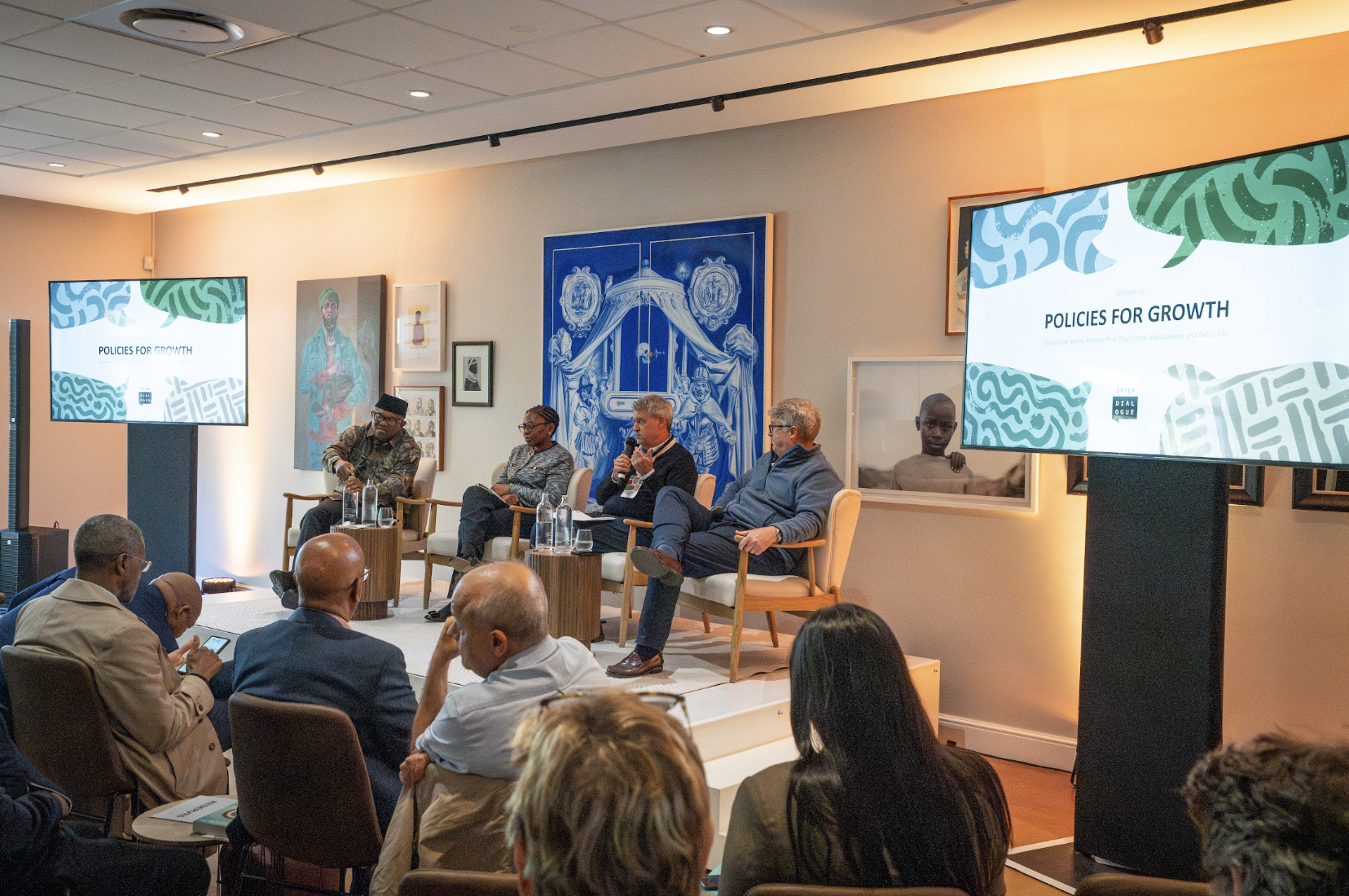
Session 5: Policies for Growth
Overview
The final session brought together three voices from different vantage points — an Argentine economist with international development experience, a leading Zambian political advisor, and a former Nigerian presidential candidate — to address the most fundamental question of the Spier Dialogue: what actually makes economies grow, and why has Africa not grown fast enough? The session moved between economic theory and practical policy, between structural analysis and moral accountability, and reached conclusions that were, in the end, more convergent than the different starting points suggested.
The economics of growth: what the theory tells us
One contributor opened with a theoretical grounding. The Solow model — output as a function of labour and capital — is a useful starting point, but its most important insight is a third ‘residual’ factor: more than 60% of economic growth cannot be explained by measurable inputs of labour and capital. This Solow residual is a standing reminder that the things we cannot easily quantify — institutions, trust, the quality of governance, the rule of law — are in fact the dominant determinants of economic performance.
Human capital is the most tractable of these. People who are better educated and healthier produce more. But human capital investment is a long-cycle activity, and its returns depend on the institutional environment in which it is deployed. A well-educated workforce in a country where property rights are insecure, the judiciary is politicised, and monetary policy is contaminated by the electoral cycle will not deliver its potential. The framework conditions matter as much as the inputs.
The same contributor's account of the elements required for growth was comprehensive: education and health as the human capital foundation; an independent judiciary that gives investors confidence their assets are secure; monetary policy insulated from political interference; political stability; and physical infrastructure. Beyond the public sector's domain: financial inclusion, well-functioning capital markets, the capacity to leapfrog through AI and digital technology, regional integration, and counter-cyclical fiscal institutions that convert commodity windfalls into long-term savings rather than short-term consumption.
He offered a pointed comparative observation: Africa has outperformed Latin America in growth terms for three decades. Yet Africa has twice as many people producing half as much output. The productivity gap — not the growth rate — is the measure that matters for living standards.
"More than 60% of growth is explained by the residual — a standing reminder of the things we cannot pin down"
William Hague's four Fs
The same contributor drew on the former British foreign secretary William Hague's framework for economic regeneration, which identifies four conditions:
• Frustration: the recognition that things need to change — without it, there is no energy for reform.
• Flow: the liberalisation of ideas, decentralisation of decision-making, and removal of obstacles to initiative.
• Fusion: the integration of new technologies with human capabilities, without allowing the former to displace the latter.
• Framework: a values framework within which leadership operates — one characterised by humility, and by the discipline of preparing rather than predicting.
The last point — preparing rather than predicting — has particular resonance in the African context, where the temptation to set ambitious long-term targets has often served as a substitute for the harder work of building the institutional capacity to achieve them.
From theory to practice: the Zambian experience
A second contributor brought a practitioner's perspective. The most important insight was methodological: data is not merely an input to policy design; it is the feedback mechanism that makes implementation work. Too many African governments adopt headline policies without building the continuous learning loops needed to know whether those policies are working, and to adjust when they are not.
Zambia's own recent trajectory illustrates both the challenge and the possibility. The country moved from GDP growth of -2.7% to a positive 5-6% for the current year — a significant improvement. Education reforms are concrete: a free education policy has brought more than two million additional children into classrooms; 37,000 teachers have been employed in four years; a feeding programme is reaching 2.2 million people. The deficit of 146,000 teachers is a measure of what remains to be done, but the direction of travel is established. The argument was not that Zambia has solved its development challenges, but that evidence-based, continuously monitored policy is the discipline that separates genuine progress from rhetorical commitment.
Leadership failure is the root cause
A third contributor delivered the most unsparing diagnosis of the session. Africa, he argued, has no reason to be poor. It is the second-largest continent, the second most populous, and holds the highest mineral reserves of any region in the world. India, which occupies roughly one-tenth of Africa's land area, produces six times as much economic output. The explanation for this gap is not geography, resources, or the capabilities of Africa's people. It is leadership specifically, the decades-long failure of African leadership to prioritise the public good over personal enrichment.
The cost of governance in Africa is unacceptable. The money that is diverted through graft and misspending could be lifting people out of poverty. The failure to invest in education and health is not a resource constraint; it is a choice. It is a choice made by leaders who are not committed to the development of their countries.
"Africa has no reason to be poor. What you are seeing in Africa is leadership failure over the years that has produced incompetent leadership"
His prescription followed from this diagnosis. The requirements for growth are not technically complex: good governance and competent leadership; investment in education and health; and the use of small businesses as the primary vehicle for poverty reduction. None of these requires external resources or favourable global conditions. They require African leaders to look inward, to take responsibility, and to demonstrate that good leadership is possible. The starting point is Africa itself — its people, its resources, its capacity to change — and the only obstacle is the quality of its leadership.
A convergent conclusion
Despite their different entry points, the three speakers converged on a conclusion that echoed through the entire dialogue at Spier: the binding constraint on Africa's development is not its demographics, not its resource endowment, not the global environment — though all of these matter — but the quality and accountability of its governance. The demographic dividend will not materialise without it. Cities will not become productive without it. Migration will remain a source of strain rather than dynamism without it. Growth will remain insufficient without it.
The closing note was not despairing. Zambia's turnaround, the Western Cape's tech sector, the spread of mobile money across the continent, the entrepreneurial energy visible in African cities — these are evidence that the capacity for transformation exists. The question that Spier left open is whether the political conditions for releasing that capacity can be built, and built fast enough, in the time the continent has.
Session 6: Implementation — Rising to the Challenge
Overview
The final session addressed a failure mode that cuts across every other theme of the dialogue: the gap between planning and execution. Across Africa and in the international programmes designed to support it, the problem is rarely a shortage of strategies, frameworks, agreements, or announced intentions. It is the inability — or unwillingness — to implement them with discipline, to track progress honestly, to communicate transparently, and to plan for what comes after the initial moment of commitment. Three speakers, drawing on experience in American development programming, African governance, and the Great Lakes conflict, each arrived at the same diagnosis from different directions.
Lessons from American development programmes
One contributor drew on direct experience of several US government aid initiatives to identify the characteristics that distinguish programmes that work from those that do not. Power Africa, launched under the Obama administration, was an example of effective design: it had a clear mandate, mobilised the private sector with genuine energy, and galvanised resources around a specific, measurable objective. The Somalia transition work under the same administration offered a different kind of lesson — the value of granular, step-by-step tracking of progress, what the contributor described as ruthless accountability for implementation. Both examples share a discipline that is more the exception than the rule.
The most common failure, one contributor argued, is a cycle of announcement and silence. Governments and development actors make commitments publicly, attract attention and resources at the point of announcement, and then go quiet. Stakeholders — citizens, partners, investors — are not kept informed of what is happening, what has changed, and why. The discipline required is the opposite: overshare, overcommit, overdeliver. It is better to overdeliver on a modest promise than to overpromise and underperform, but better still to communicate continuously throughout.
Kennedy's establishment of USAID and the Peace Corps, and his practice of meeting regularly with African leaders, represented a model of sustained personal and institutional engagement that has rarely been replicated. The Reagan administration's transition planning was another example of disciplined preparation. By contrast, the current administration's posture on the Rwanda-Congo situation — celebrating outcomes before the process is complete — illustrates the costs of premature declaration of success.
"Overshare, overcommit, overdeliver. Too often we make an announcement and then go silent”
A structural failure identified extends beyond individual
programmes: the absence of planning for what comes next.
Governments and international actors invest heavily in negotiations, transitions, and peace processes, but rarely ask what success actually requires in the period that follows.
AGOA — the African Growth and Opportunity Act — provided a telling illustration: after the first ten years of trade preferences, trade flows returned to pre-AGOA levels. The programme created temporary conditions without building the durable productive capacity that would have made those conditions self-sustaining.
African agency and the imperative of intentionality
A second contributor reframed the implementation challenge as fundamentally a question of African agency. The continent's development trajectory has been shaped too long by external pressures — the conditionalities, priorities, and frameworks of aid donors — rather than by African leadership making deliberate choices about the direction of their own countries. Botswana was cited as the model: a country that has managed its resource endowment with discipline and long-term purpose, building institutions rather than distributing rents.
The contrast with the current pattern is sharp. The largest wind farm in Kenya is externally exploited — the benefits of African resources flowing abroad rather than being captured for African development. This is not inevitable. It is the result of the absence of intentionality in how African governments approach their natural assets and their relationships with external investors.
On governance, this contributor was direct: it cannot improve without leadership grounded in the rule of law. The failure to create jobs for Kenya's well-educated youth is not a technical problem — it is a governance problem, a failure to make the deliberate decisions that would connect human capital to economic opportunity. The call was for leadership that takes responsibility, acts with intention, and measures itself against results rather than announcements.
The Great Lakes: implementation failure as human catastrophe
A third contributor brought the implementation question into its starkest relief through the lens of the Great Lakes conflict. Franz Fanon's observation — Africa is a gun and Congo is the trigger — retains its force. The DRC's population has more than doubled in thirty years, from 60 to 120 million. This demographic reality has direct and obvious policy implications that have been consistently ignored or deprioritised in successive peace processes.
The 2014 World Bank framing of the emerging African middle class and the demographic dividend was, the contributor argued, a double-edged intervention: it created a positive narrative that allowed African leadership to escape accountability for whether the conditions for that dividend were actually being built. The gap between the aspiration and the reality in the Great Lakes is not primarily a resource problem or a design problem. There is no shortage of peace agreements, platforms, or donors. There is a chronic and persistent shortage of political will to implement.
The proliferation of peace tracks — Doha, the African
Union, the European Union, the United Nations — has created the conditions for forum shopping: parties to the conflict can move between processes, selecting whichever forum is least demanding at any given moment, without ever being held to account for implementation in any of them. The result is that the Great Lakes conflict has been churning for more than thirty years without resolution.
"There is no shortage of peace agreements, platforms, or donors. What is lacking is implementation. There is a lack of political will"
Two structural requirements were identified. The first is regional inclusion: any peace process for the DRC must be as much about Uganda and Burundi as it is about the DRC and Rwanda. The conflict is regional and the solution must be regional. The second is national inclusion: the people most affected by the conflict are not represented in the processes designed to resolve it. This is not merely a procedural failure — it is a guarantee of implementation failure. People who are not part of the solution will become part of the problem in implementation. Exclusion from the process produces rejection of the outcome.
The demographic point was the final and perhaps most important one. The population of the Great Lakes region has more than doubled over the period of the conflict. Any peace agreement that does not take this into account — that does not address land, livelihoods, and the aspirations of a doubled population — is building on sand. The failures of implementation in the region are not accidental. They are the predictable consequence of designing solutions for the region as it was, rather than for the region as it is.
The thread that runs through everything
The implementation session brought the Spier Dialogue to a conclusion that was both sobering and clarifying.
Every session had identified the right diagnosis: the demographic dividend requires investment in human capital; cities require fiscal empowerment; migration requires administrative capacity; growth requires governance; peace requires political will.
The implementation session named what stands between the diagnosis and the outcome: the discipline to track progress honestly, to communicate transparently, to include those who will bear the consequences, to plan for the morning after the agreement is signed, and to hold leadership accountable not for what it announces but for what it actually delivers.
Discipline — more than resources, more than strategy, more than external support — is what Africa's challenges require and what its people deserve.